

Snow
A kid adventure in Central Park

“Mom. It’s not like I’m going to die or anything.”
That’s Liza, my ten-year-old daughter. It is 2005, and we have recently returned to Brooklyn after a six-year sojourn in a small town north of the city. I am still getting my bearings as a new school year begins. And right away, Liza starts begging me to let her walk alone to her school bus stop three streets from our apartment. She is as persistent as a lawyer in court, who, sensing that victory is at hand, refuses to let up on a line of questioning despite repeated—though increasingly exhausted—cries of “Objection!” from opposing counsel.
And there are objections. She would have to cross Fifth Avenue and Union Street, a busy intersection, where just last week I, outraged urban mother, cussed and flipped the bird at a guy making a reckless turn.
“He could have killed us!” Tough guys in bloated SUVs are my nightmare. Also, my parenting life has been burdened by the tragic story of Etan Patz, who in 1979 left his parents’ apartment in downtown Manhattan to walk to school and never returned home. My friends and I don’t need to talk about this long-ago event, because for us it is still present, as if it happened yesterday. So, no walking to the bus stop alone.
My daughter is disappointed, though I think she was impressed with my cussing and bird-flipping.
Some concessions have been made. She can now walk around the corner, alone, to our neighborhood grocery store to buy treats. “My first receipt! My first receipt!” she shouted after her maiden solo expedition, prancing around the living room with the satisfaction of a cyclist flying over the finish line of the Tour de France, arms upraised in victory. Lobbying efforts for further freedoms continue.
When I began third grade in 1968, my parents decided that my brother Simon and I could make the trip to school by ourselves on New York City public buses. In these more cautious times, we fret about child kidnappings and car accidents and arm our children with cell phones, yet I have met other adults who grew up in the city before 1979, who went to school alone at a young age. My mother never explained anything to us about child-focused crime. Perhaps, although the city was more ragged, we were all more innocent. Liza understood the language of danger at an early age, but when I was a child, if you didn’t talk about it, it didn’t exist, despite all visible evidence to the contrary.
During that winter, long before cellphones, in a city plagued with grime and crime, Simon and I were latchkey kids, returning home to a babysitter in the afternoons. We attended a private school on 79th Street between Fifth and Madison Avenues, but we lived on the shabby Upper West Side. The avenue was still cobblestoned in those days—I loved listening to the sound of the cars rattling down the street during a rainstorm.
Down the hill on 97th Street was the incongruously named Hotel Paris (now an elegant co-op), where, before real estate frenzy swept these northern reaches, pimps in white flared suits and wide brimmed hats stepped out of long white limousines, escorting their flashily dressed wares on their arms. These exotic men, and especially the women, seemed impossibly glamorous to me. I was dressed in pleated skirts, Peter Pan collared shirts, knee socks and button-hooked Mary Jane’s. Though an assault on my intellectual parents’ aesthetic tastes, the pimps and spangled women were more benign than the SUV drivers on Fifth Avenue in Brooklyn. At least they drove their limos at a dignified speed.
Both my parents worked. When we were younger, we traveled to school on a private van, but now that I had reached third grade we would be on our own. My mother took us two or three times to show us the way. Down Broadway on the 104 Bus, tightly clutching our bus passes in their plastic sleeves, then the crosstown bus at 79th street from Broadway, across Amsterdam and Columbus Avenues, Central Park West, and through the park to Fifth Avenue. Her final cautionary words: “Here is my office number. Look both ways crossing the street. Don’t talk to any strangers. Be sure to take good care of your brother.” I was Simon’s serious older sister, with a firm grip on his hand.
One morning, following a huge snowfall, Simon and I left our apartment to head off to school. There had been no escape from the snowsuits my mother presented to us on winter mornings. Our snowsuits were dark blue, held up with uncomfortable suspenders, seriously puffy and—even for young children without a self-formed fashion sense—a complete humiliation. Once encased in padded nylon, our legs in motion produced a persistent swish, as irritating as fingernails scraping a blackboard. Not to mention the too-soon soggy woolen mittens attached to strings threaded through our woolen coat sleeves and the itchy scarves and hats secured with chafing under-the-chin fastenings.
The trip down Broadway was slow that morning, the streets clogged with snow. At 79th Street we boarded the crosstown bus. The engine revved and strained as the driver attempted the hill, exactly the vroom vroom noise my brother made when he played with his Matchbox cars. After a few more attempts, the driver shut off the engine, opened the doors.
“Out of service,” he announced, and we filed out with the other passengers.
We stood around for a while wondering what to do. We were good kids; we mostly did as we were told (except, of course, when we did not). But there we were, stranded, alone, except for our mother’s magical powers as a disciplinarian, the awesome omniscience of an unseen god.
What would she want us to do? I wondered. Somehow, we had to get to school. The thought of returning home never occurred to us. Going home would be a day off. Our mother didn’t take days off.
A group of older girls converged. Simon knew some of them from our school. Ninth graders in bellbottoms and flippy pony tails (no snowsuits), they thought Simon was adorably cute with his mop of dark curly hair, freckles, thick glasses and a patch over his stronger right eye (the left eye was a wanderer). The girls told us they were walking through the park and encouraged us to follow them. “We’ll take care of you guys! Come with us!”
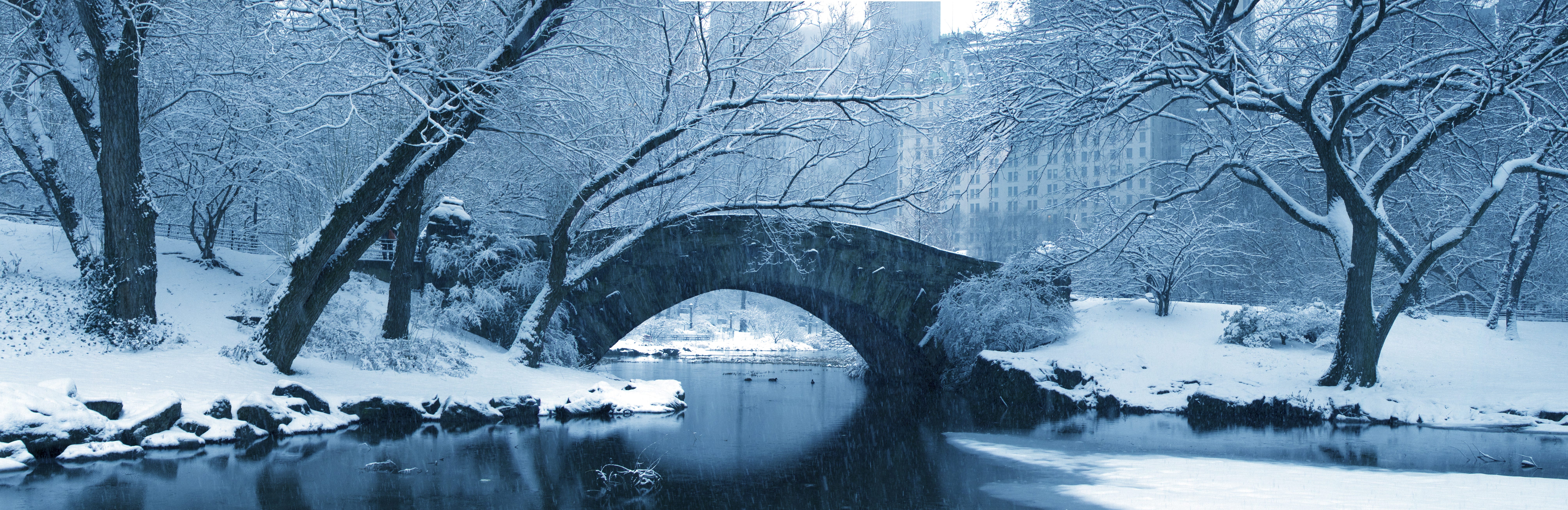
So we did. The serious older sister let go of her brother’s hand. We trailed at a distance across the hushed avenues and into the park. In the park, the profound, dense silence of New York City after a blizzard, absent the hum of traffic, the gray tree skeletons transformed with a coating of fluffy sugar frosting. I don’t remember that Simon and I talked a lot. I don’t remember that we dropped our school bags and suddenly, overtaken with the thrill of unexpected liberty, began a snowball fight. I remember the quiet, our swishing snowpants, our crunching boots, and the fear and thrill of something forbidden.
A forbidden adventure nevertheless filled with purpose. We were pioneering Antarctic explorers hunting for the South Pole. We were mountaineers, summiting Everest. We were warriors hunting for deer with bow and arrow. We were lost in the fairytale wilderness of one of our storybooks, escaping from a cruel wart-nosed witch who lived in a cottage perched on chicken legs.
When we arrived at school, our teachers were shocked to see us. Without discussion, Simon and I understood that our morning adventure would remain a secret. And so it did, until I called my brother many years later to see if he remembered that day. For both of us, the memory had taken on the quality of a waking dream.
Despite the real dangers, I moved home to the city so that my daughter could experience life unvarnished. Homeless people are real, and so are the rude exchanges of drivers and pedestrians at crosswalks. Here we see the harshness of racism and poverty and the selfishness of a truly material age. Also real are inspiring street performances as well as random acts of urban kindness and absurdity that open the heart.
“Mama, I’m here…where are you?” Faced with a situation such as Simon and I encountered, Liza called me using her bright caterpillar green cell phone, on the two or three afternoons last school year when I was late reaching her bus stop, having endured the frequent delays of the New York City subway system. I was grateful then for her common sense and modern communications technology. On the other hand, I worry that with so many digital safeguards in place she and other children won’t learn to think for themselves when presented with the unpredictable. Worse, that their scheduled lives won’t leave room for the unpredictable.
I hope that she will have eye-opening adventures in this city that will be hers, situations I will not always be able to control or monitor. I hope that I can allow her that freedom, full of risk, where creative experiences and of course, mistakes, so essential to the process of mastery, really happen. I hope I can stop hovering.
The thought of her crossing Fifth Avenue in Brooklyn at rush hour still makes me break out in an anxious sweat. And today she left her lunch bag on the morning school bus, reminding me that despite her pleas for independence, she is still a child, who needs my care. Every time she says, “Mama, I have a question,” I take a deep breath, wondering if it’s going to be the fiftieth query about the three-block walk to her bus stop. She’s just started fourth grade, and winter is coming.
This essay first appeared in different form on Mr. Beller’s Neighborhood.